
Business connections through sport
Every week, a new tool appears that promises smarter, faster and more digital networking. And that's true. Still, we see that strong business relationships are built within a close-knit community. And nowhere does that happen as naturally as around sport.
Sport has always brought us together
Long before business clubs existed, people came together around sport. More than 3,500 years ago, communities in Central America built special ball courts, with space for spectators along the side. From 776 BC, every four years, thousands of people from across the Greek world travelled to Olympia. This was the origin of the Olympic Games. And every Greek city had a gymnasium: a place to train, but also to talk, to learn and to get to know each other.
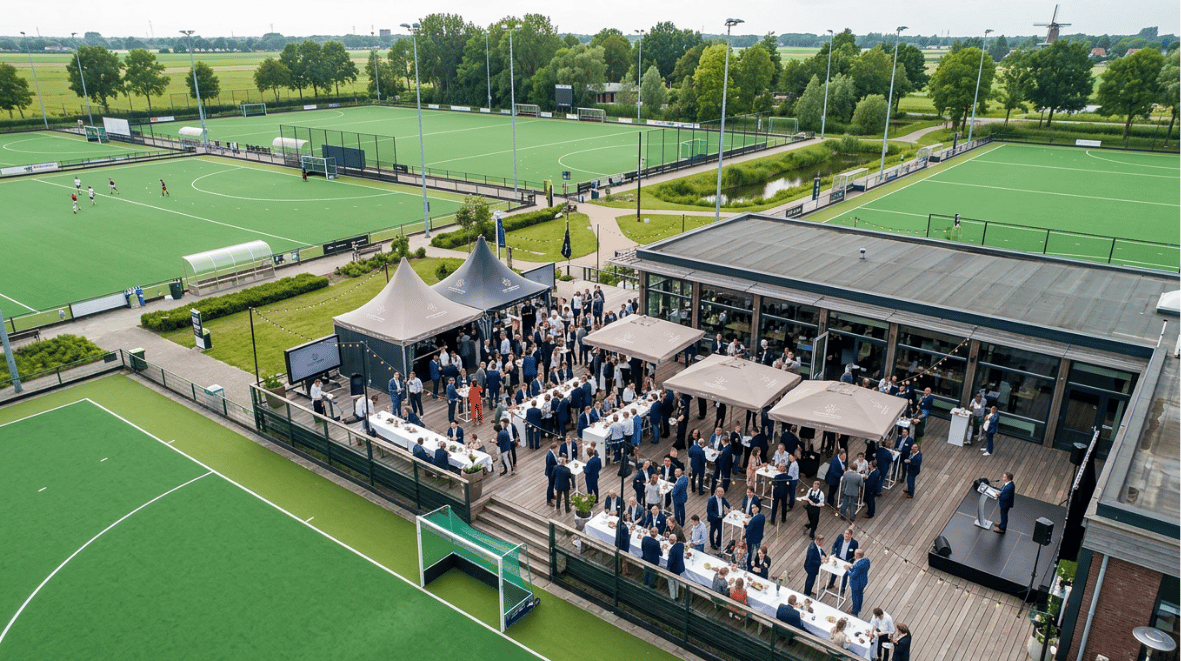
The form may have changed, but the pattern hasn't. From the stadium in Olympia to a hockey clubhouse on a Saturday afternoon, sport gives people a reason to come together.
Why the digital age doesn't change that
You might think technology makes meeting in person less valuable. We see the opposite. The more we do digitally, the more valuable it becomes to really talk to someone. Today, national sports programmes in the Netherlands name local businesses and regional networks as part of the social value of clubs.
Research by Statistics Netherlands (CBS) shows that a sports club is still the type of association Dutch people most often belong to. It is also striking that people who are not members have taken part in club activities more often since the pandemic.[*] The need for a personal conversation hasn't gone away.
Data makes meetings better
Does this mean everything should stay the way it has always been? No. Many business networks around sports clubs still run on chance. Who will you talk to tonight, and do the companies in the network really form a cohesive group? We believe many opportunities are still being missed. Dzjie sees the value in recommendations and meaningful contacts, rather than a board along the pitch or a logo on a website. The real value lies with the people you don't know yet. This is especially true in grassroots sport and in business clubs.
This is where data helps. Data can show which entrepreneurs don't know each other yet but could mean something to each other. Which topics matter to members. Who hasn't been around for a while, or who hasn't yet seen enough value in the network and is thinking about leaving. We want everyone to go home after a business event with a conversation that mattered.
What we believe
People will keep meeting each other. They did it in Olympia, they do it along sports fields all over the Netherlands, and they will keep doing it, however much AI changes the job market and the world.
Major industry reports say that stadiums are becoming meeting places for the whole community, and that they will soon be judged not only on financial return but also on impact.[*] But the business community around the amateur club, where entrepreneurs see each other on the sidelines every week, stays out of the picture. That is where we see the opportunity.
For us, it's about organising these meetings so they deliver more. For the entrepreneurs, for the club and for the region. Sport has connected people for thousands of years. With the help of data, it can do so even better for generations to come.
Which meeting on the sidelines has brought you the most in business?